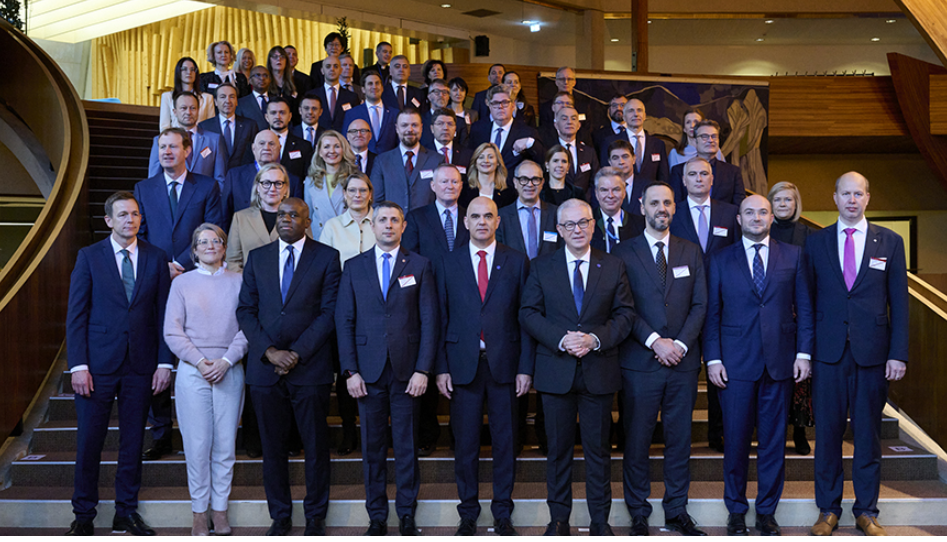
An informal ministerial conference took place in Strasbourg on human rights day, 10 December 2025. As is explained in more detail below, this exceptional gathering was prompted by a letter of nine ECHR states of about seven months earlier. The ministerial conference resulted in the adoption of conclusions, which invited the Committee of Ministers, among other things, to prepare a ‘draft political declaration’ on the Convention and migration. Before discussing the statements delivered at the conference and the conclusions in more detail, this blog summarises the aforementioned letter and the reactions to it, as well as previous ministerial conferences and their results.
The letter of nine
On 22 May 2025, nine ECHR (and EU) states published a letter, addressed to no one in particular, aiming to ‘launch a new and open minded conversation about the interpretation’ of the ECHR in order to ‘restore the right balance’. More specifically, they believe, among other things, that there should be ‘more room nationally to decide on when to expel criminal foreign nationals’. They also believe that they ‘need to be able to take effective steps to counter hostile states that are trying to use our values and rights against us’, including by ‘instrumentalizing migrants at our borders’.
The letter has probably set in motion more than the signatories expected. Unsurprisingly, many reactions have appeared in the blogosphere. Setting aside the letter’s content for the moment, Steininger observed that it ‘is apparent that the letter is not sufficient to account for an actual attempt at institutional reform (so far)’. Like Steininger, Ní Chinnéide and Sevrin emphasised that that this type of backlash or tension is nothing new. Meanwhile, Buyse wrote that, by choosing to publish an open letter, ‘the governments behind the open letter [are] putting a new round of pressure on the Court’. Donald and Forde added that, even though the letter does not explain ‘what they seek to reform, how and why’, it is clear that that the states ‘intend to change something’. So, although the letter is not addressed to the Court, it is clear that the Court is the primary target audience and that the nine states intend to initiate a change that is not yet clearly defined.
The AGORA group – a new ‘pan-European platform committed to open dialogue, rigorous inquiry, and balanced, evidence-based debate’ on ECHR issues – published an open letter on behalf of around 150 legal academics and advocates. The letter emphasised the need to discuss the ECHR system ‘in a manner that is consistent with the’ CoE values and standards, ‘in particular the rule of law and democratic governance’. The letter echoes the statement of ENNHRI, the European Network of National Human Rights Institutions. The AGORA group also recalled that, in the Reykjavík Declaration of May 2023, the CoE member states had reaffirmed their ‘unwavering commitment to the Convention system as a mechanism to promote peace and stability in Europe and the [CoE’s] core values of human rights, democracy and the rule of law’.
The letter did not go unnoticed among ECHR states parties either. To take one example, the office of the Belgian Prime Minister De Wever, who was one of the signatories of the letter, asked Bossuyt to write a paper addressing the concerns expressed in the letter. Bossuyt is a former president of the Belgian Constitutional Court. The idea was to ‘quietly circulate the confidential paper among European leaders’. In line with the paper’s recommendations, De Wever proposed not amending the Convention, as this would take too long. Instead, he would like to add a further undefined ‘interpretation protocol’ to the ECHR. As Donald explained, ‘it is not clear whether De Wever does in fact mean a protocol to the ECHR or, more likely, an interpretive declaration’.
To take another example, the Dutch parliament responded to the country’s decision not to sign the letter by passing a motion calling on the Dutch government to explore the possibility of modernising or revising treaties such as the ECHR. The Dutch parliament also adopted a motion in support of De Wever’s idea after he delivered a speech at the HJ Schoo Lecture, which marks the unofficial start of the Dutch political year. In this speech, he also addressed the issue of migration and the ECHR. In line with the second motion, the Dutch government’s position during the informal ministerial conference was that the participants should instruct the Committee of Ministers to adopt a political declaration at the ordinary ministerial conference in May 2026. This declaration should have the status of an ‘interpretative declaration’ (rather than a ‘protocol’, as De Wever suggested), thus providing further guidance on the interpretation of the ECHR in the context of asylum and immigration policy. Interpretative declarations are a known phenomenon in international law.
The Court has firmly stated that it has the authority to determine the validity under Article 57 ECHR (Article 64 at the time) of ‘a reservation or, where appropriate, of an interpretative declaration’.
Council of Europe reactions
Within the CoE, the Court responded to the letter by introducing some evidence to the debate in the form of a factsheet about immigration. The factsheet shows that only 1.5% of the cases pending before the Court relate to immigration. Furthermore, the Court identified violations in approximately 6% of the immigration-related applications over the past ten years. The CoE Commissioner for Human Rights wrote that the letter contains ‘so much to repudiate and challenge’ and that it ‘posits
evidence free claims’, which underlines the importance of the Court’s factsheet.
The CoE Secretary General Berset explained that ‘[d]ebate is healthy, but politicizing the Court is not’. He also emphasised that ‘[u]pholding the independence and impartiality of the Court is our bedrock’. In addition to outlining four ‘basic factual premises’ for measures to address the concerns ‘of some European political leaders regarding the issue of migration’ and the Convention, Berset proposed four avenues to address these concerns. I will return to one of them when discussing the conclusions. It is Berset who initiated the informal ministerial conference with the aim of re-establishing discussions within the CoE framework. As Donald and Forde explained, ‘the advantages of utilising established fora as opposed to informal back-channels to discuss fundamental structural or normative issues is that discussions are more structured, comprehensive and transparent, and the involvement of expertise ensures that any course of action taken is based on facts and consideration of potential consequences’. The conference also ensures that all 46 Convention states participate in the discussion, rather than just 9 EU states.
The statements delivered at the informal ministerial conference
At the conference on 10 December 2025, 27 states delivered a joint statement. 19 of these states are EU states.[i] The following EU states were missing: Cyprus, France, Germany, Greece, Luxembourg, Portugal, Slovenia and Spain. After confirming their ‘commitment’ to the Convention (rather than their ‘unwavering commitment’ as in the Reykjavík Declaration), the states echoed the letter of the nine states in many ways, referring to ‘people who take advantage of our hospitality by committing serious crime’ and the need to protect their own populations. More specifically, they considered it ‘vital that the balance between individual rights and legitimate aims as per Article 8 […] is adjusted so that more weight is put on the nature and seriousness of the offence committed and less weight is put on the foreign criminal’s’ interests. Comparably, they stated that the ‘scope of “inhuman and degrading treatment” under Article 3 […] should be constrained’ in the manner they see fit. Neither a group of states, nor the Committee of Ministers under the Convention or the CoE Statue has the competence to interpret the Convention; this competence lies solely with the Court (Articles 19 and 32(1) ECHR). For this reason alone, the proposed ‘rebalancing’ under Article 8 and limiting the scope of Article 3 are highly problematic. Therefore, these states ‘support’ for the Court’s independence is merely paying lip service to this key concept.
The CoE Commissioner for Human Rights’ statement is of a wholly different nature and highlights further reasons why the joint statement is problematic. In his brief statement, O’Flaherty raised some very pertinent issues. First, he emphasised the importance of ‘impeccable facts’ and, in this context, described the claim that the so-called instrumentalisation of migration undermines national security’ as ‘unconvincing’, while also challenging the assumption that adjusting the Court’s practice will ‘impact irregular migration flows’. He also urged the states not to ‘throw the law in question’ – specifically, the universality of human rights, the absolute prohibition of refoulement, and the Court’s independence. O’Flaherty was ‘convinced that our peoples are not against strong human rights protections for everyone’.
Although Secretary General Berset’s statement is less critical, he mentioned that the letter does not reflect his views. He underscored the importance of political dialogue and the evolving nature and significance of the Convention. While describing migration as having a ‘human face’, he also outlined the ‘challenges of irregular migration’, including its instrumentalisation.
Conference conclusions
The first few preambular paragraphs of the conclusions are rather general, referring to the ‘need to preserve the integrity of the Convention system’, the ‘the unconditional obligation on States to abide by the final judgments of the Court’ and the ‘subsidiary nature’ of the Convention system, for example. The final preambular paragraphs address the ‘migration challenges’ that supposedly prompted the debate initiated by the letter of nine. According to the conclusions, these challenges include the ‘instrumentalisation of migration, smuggling of migrants, trafficking in human beings and other criminal activities in this context’. A category of ‘challenges’ that is highlighted separately is ‘related to the expulsion and return of foreigners convicted of serious offences, while respecting human rights’. Additionally, the participants at the conference acknowledge a wide range of issues that appear to be the result of a complex compromise: ‘the fundamental responsibility of governments to ensure national security, public safety and the economic well-being of the country, as well as their sovereign right to protect their borders, whilst respecting without discrimination the core values of human rights, democracy and the rule of law, and conscious of the financial challenges encountered by multilateral co-operation on migration issues’.
The operative paragraphs of the conclusions invite the Committee of Ministers to:
‘a) prepare a draft political declaration reaffirming the obligation to ensure the effective enjoyment of the [Convention] rights […] to everyone within the jurisdiction of member States in the context of the contemporary challenges posed both by irregular migration and by the situation of foreigners convicted of serious offences, taking duly into account in particular governments’ fundamental responsibility to ensure national security and public safety;
b) reiterate its support for the elaboration of a new recommendation on deterring and fighting the smuggling of migrants, with full respect for their human rights;
c) consider how the [CoE], including through the possible creation of an inter-governmental committee, can best address pressing migration issues and related policies;
d) encourage the Secretary General to engage in discussions at an international level relating to migration.’
The first proposal is clearly the most conspicuous. It is difficult to predict the content of this political declaration based on the proposal, since the proposal is hard to decipher and ambiguous. The political declaration should reaffirm the obligation to protect everyone’s Convention rights in the context of migration challenges on the one hand. This almost seems to contradict the joint statement, which proposes reducing the protection afforded by the Convention to ‘address’ migration challenges, and is also not in line with the spirit of the letter. On the other hand, the addition that the political declaration should duly take into account governments’ responsibility to ‘ensure national security and public safety’, is more in line with the joint statement and the letter: the ‘migration challenges’ and the protection of human rights undermine the governments’ ability to fulfil this responsibility.
The proposal is less clear and less controversial than Berset’s ‘avenues’, since he proposed not only the adoption of a ‘declaration on migration and the Convention’, but also that the text of the declaration ‘clearly indicate how the High Contracting Parties understand the Convention in migration cases, including in relation to criminal activities’. This proposal signals more clearly than the conclusions that the states intend to influence the Court’s interpretation of the Convention.
Apart from its content, the form of the proposal is notable: a political declaration, rather than the interpretation protocol that De Wever proposed, although he may actually have meant a political declaration. Political declarations were adopted at the five high-level conferences dedicated to the future of the ECtHR, which took place between 2010 and 2018. In these declarations, the states took stock of the reform process, identified problems concerning the Convention system and proposed reform measures. I previously found that more than half of these proposals had not been implemented, primarily due to opposition from the Court. However, the Court did take a considerable number of measures to enhance its ability to process cases, it has reduced the number of interim measures granted, and it has placed greater emphasis on the subsidiarity principle in its case law. Secretary General Berset also noted that ‘[r]esearch and empirical evidence show that the Court is not indifferent to such political declarations and considers them in its judicial work’. Donald and Forde confirmed that ‘judges live in the real world, and they pay attention to the perspectives of states’. Therefore, such a declaration may be a way for the states ‘to inform and perhaps even “nudge” the Court in a certain direction’. Additionally, Buyse noted that the debate about the Convention could lead to ‘subtle shifts in case-law’. Unlike the proposal made by the Dutch delegation at the informal ministerial conference, the declaration is not specified as having the status of an interpretative declaration.
The timing of the conference at which the political declaration will be proposed is unclear. It could be adopted at the ordinary ministerial conference, which is due to take place in Moldova in May 2026 (the Dutch proposal). However, Berset proposed organising a ‘dedicated’ high-level conference, probably similar to those held from 2010 to 2018.
My conclusion
Discussions about the Court in 2026 will continue to focus on migration and the ECHR, and a political declaration on this topic is expected. If the declaration reflects the joint statement, it will call on the Court to significantly reduce human rights protection for (certain categories of migrants). According to some (see also here), this process has already begun and it may be reinforced by a political declaration, since the Court has not been not insensitive to such declarations. Despite the both legally and empirically questionable basis of their proposals, a significant proportion of ECHR states parties are determined to follow this course. However, since a political declaration requires the approval of all 46 states parties, its content will likely be more nuanced than the joint proposal, as the conclusions adopted at the information ministerial conference also suggest. Still, dynamics in the states may lead to states changing their attitude, as demonstrated by the case of the Netherlands, where the Convention became the subject of parliamentary debates. Although the Netherlands did not sign the letter from the nine states, it did participate in the joint declaration, which is likely to have been a consequence of the debates.
[i] Austria, Belgium, Bulgaria, Croatia, Czech Republic, Denmark, Estonia, Finland, Hungary, Ireland, Italy, Latvia, Lithuania, Malta, Netherlands, Poland, Romania, Slovakia, Sweden. The non-EU states are: Albania, Iceland, Montenegro, Norway, San Marino, Serbia, Ukraine, United Kingdom.