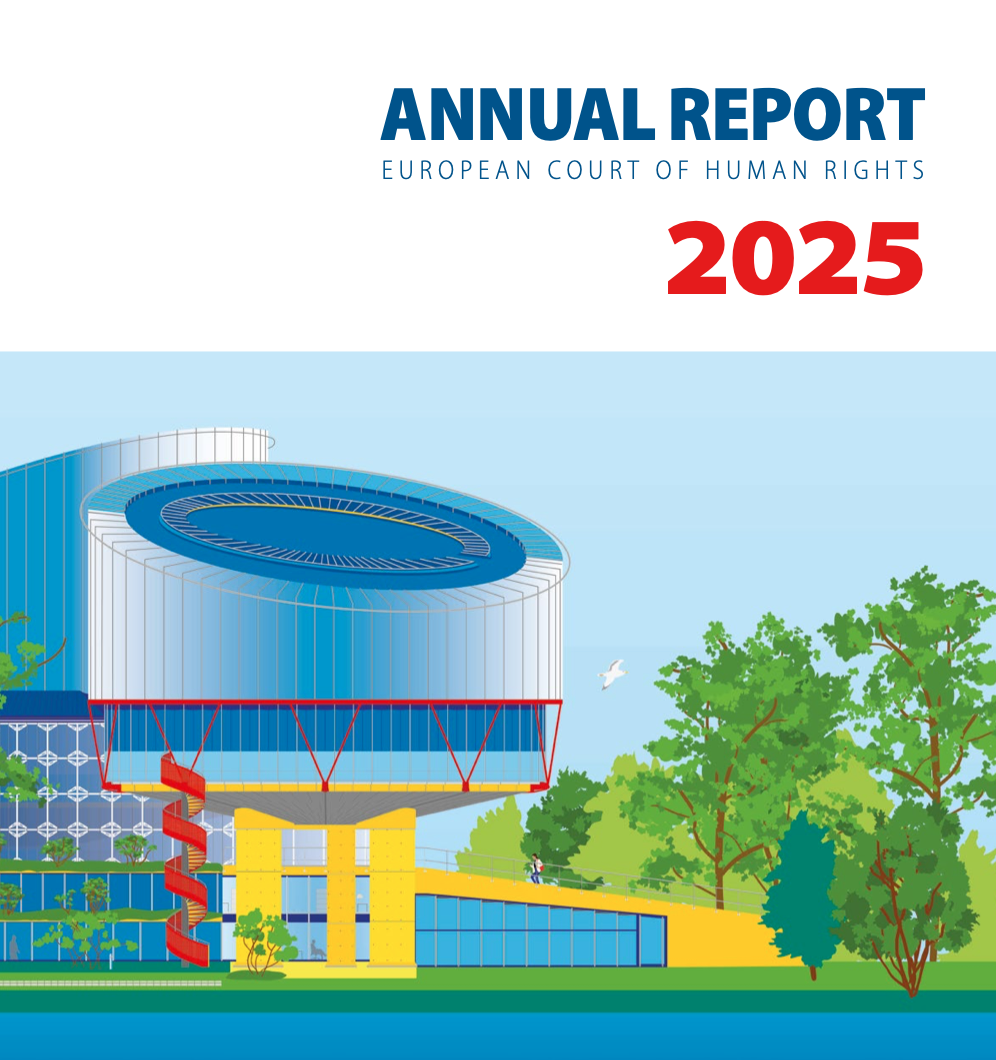

At the end of January, The European Court of Human Rights organised its opening of the judicial year and published its annual report.
At the formal opening, the President of the Court, Mattias Guyomar, in his speech called for judicial unity and solidarity in the face of changing realities in the world. He called on judges of superior courts in the Convention’s state parties, saying about the ECHR: “We are all ‘Convention judges’, having this legal embodiment of humanism, in our hands.”
The President also mentioned a number of statistics, which are to be found in greater detail in the Annual Report 2025 of the Court: the number of pending cases decreased by 11% in the past year to around 53,450 currently, even n the face of the influx of 31,000 new applications. The Court’s docket, although still very large, is through the efforts of the registry now at its lowest point in two decades. Notable, the average time of dealing Wirth impact cases has decreased from a staggering 68 months to 28 months now and the Court aims to bring this back to 1,5 year (18 months) eventually. The President also emphasised: “The European Court is both a whistleblower and a guardian of democracy and the rule of law at the European level. The Convention is our common good and applying it every day is our shared responsibility.” Al the more important of course, in the context of the ongoing political debates around the Court and the Convention.
As every year, the official opening was accompanied by a judicial seminar. This time the topic was ‘Defending media pluralism and the democratic process in challenging times.’ Four aspects were discussed more in detail: “Media pluralism and the right to information,” “Freedom of information and the competences of the European Union: the case of restrictive measures,” “The integrity of the democratic process and judicial control,” and “The free expression of the people’s will as a prerequisite for the protection of a democratic state order.” The background paper to the seminar, which discusses the Court’s case-law on these issues can be found here. The President of the Court also spoke here.